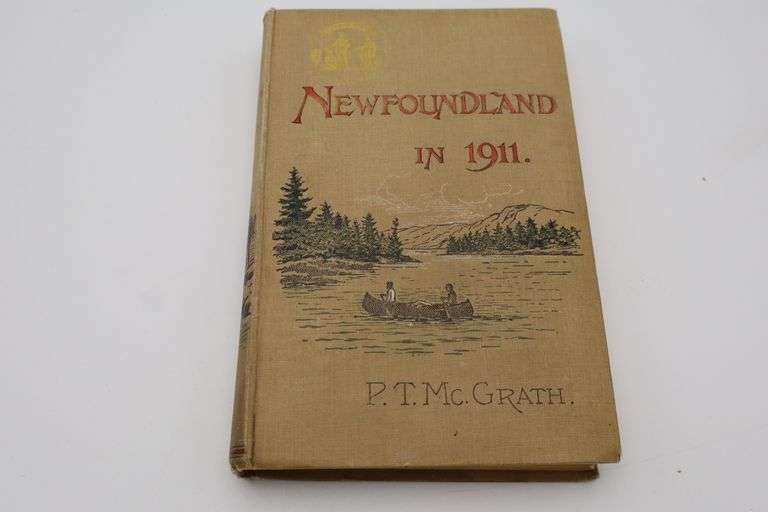
Newfoundland in 1911 by P T McGrath
What it is
-
Full title: Newfoundland in 1911: Being the Coronation Year of King George V and the Opening of the Second Decade of the Twentieth Century by Patrick Thomas (“P. T.”) McGrath.
-
Published in London by Whitehead, Morris & Co., Ltd., 1911.
-
The book is about 271 pages of text, plus ~34 unnumbered pages of plates (photographs / portraits).
Who the author was
-
Patrick Thomas McGrath (1868‑1929) was a journalist and politician in Newfoundland. Among other roles, he was Clerk of the House of Assembly, and later held political appointments.
-
Because of his roles, McGrath had good access to administrative, political, and social knowledge of Newfoundland as of 1911
Contents & Themes
Here are some of the main topics / what you’ll find in the book:
-
An overview of Newfoundland in that year: how the colony is doing in terms of its economy, industries (fisheries, mining, forestry), population, infrastructure, etc.
-
Descriptions of geography, travel, communication (roads, rail, telegraph), and how remote communities are connected.
-
Portraits and photographs of people — likely prominent individuals, perhaps community / political leaders, scenes from everyday life. (The book includes “numerous illustrations, portraits.”)
-
Some coverage of licensed guides and local services (e.g. guides in Newfoundland in 1911) — giving insight into tourism or travel arrangements of the time.
-
Probably commentary on colonial governance, as McGrath was part of the Assembly, so likely discussions of public works, political developments, possibly education, sanitation, health, etc. (common in such “progress report” style books) — though I don’t have a full table of contents.
-
Appendices: may contain things like statistical tables, lists of offices, maybe transportation timetables or commercial statistics.
Importance / Historical Value
-
The book serves as a snapshot of Newfoundland just before the First World War, at a time when the colony was adjusting to new social, economic, and technological changes.
-
It is especially useful for understanding the infrastructure, how settled communities were connected, what the fisheries looked like, how travel and communication worked.
-
Because McGrath was an insider (journalist, clerk, politician), his observations carry weight for policy, reportage, and social commentary.
-
The inclusion of illustrations / photographs is valuable for visual history (what towns, landscapes, people looked like in 1911).
