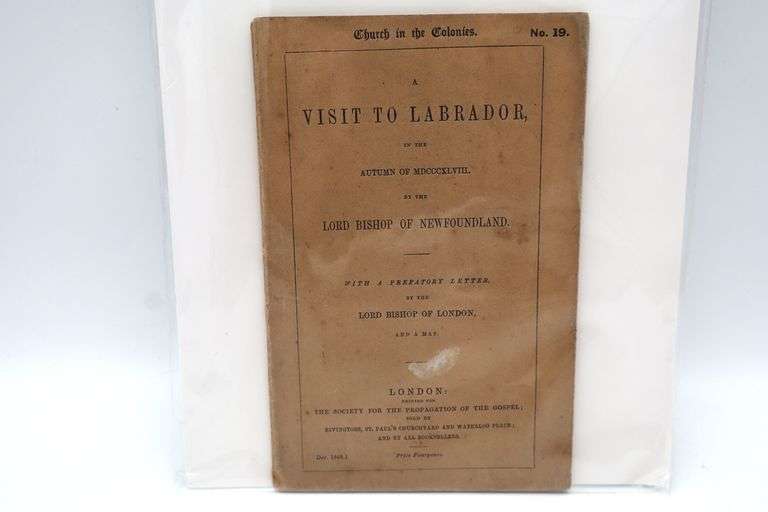
1848 Visit to Labrador Lord Bishop of Newfoundland
What it is / Bibliographic Details
-
Title: A Visit to Labrador, in the Autumn of MDCCCXLVIII by the Lord Bishop of Newfoundland. Also known as Journal of the Bishop of Newfoundland’s Voyage of Visitation and Discovery, on the South and West Coasts of Newfoundland and on the Labrador, in the Church Ship “Hawk,” in the year 1848.
-
Author: Edward Feild (Bishop of Newfoundland, 1844‑1876)
-
Publisher: Society for the Propagation of the Gospel, London; printed for SPG; sold by Rivingtons etc. First edition 1849.
-
Format: Book; ~ 126‑137 pages (depending on edition/scans); includes map(s) of the Labrador coast; images I saw reflect many scanned pages.
What’s in it / Major Themes
This journal / visit covers the Bishop’s voyage along parts of Newfoundland’s coast and Labrador, in 1848. Some of the major topics include:
-
Visitations to remote and often isolated settlement communities along South & West Newfoundland coasts and along Labrador, including places like Forteau, Red Bay, Blanc Sablon, etc.
-
Religious / missionary work: establishing or evaluating Church of England (Anglican) mission presence; assessing where spiritual care (clergy, sacraments, confirmation) is lacking.
-
Conditions in these coastal & Labrador communities: how people live, their access to clergy, schools and religious instruction; sometimes harsh travel/weather conditions; social and moral conditions.
-
Natural environment and navigation: voyages in the Church ship Hawk, challenges of sea travel (fog, storms, ice, etc.), descriptions of bays, coastline, hazards.
-
Interactions with Indigenous peoples, fishermen (from various origins: English, Jersey, Canadian, etc.), and seasonal settlements.
-
Appeals for missionary support and resources: Bishop Feild argues that certain funds / clergy are needed to meet the spiritual needs of people in the region.
Why It’s Significant
-
It’s one of the earlier detailed first‑hand accounts of Labrador coast by a church authority. It sheds light on the ecclesiastical geography (where the Church of England was present vs where there was none) at mid‑19th century.
-
It offers descriptions of settlement, infrastructure (or lack thereof), and how people in remote regions survived, which is valuable for historians of mission work, colonial settlement, and environmental history.
-
Gives perspective on what "discovery" meant in that era: often discovery in this book refers to covering religious outreach rather than mapping unknown lands; but the journey also adds to geographical knowledge.
-
It also shows how difficult it was to maintain church presence, given distances, weather, lack of funds, etc.
