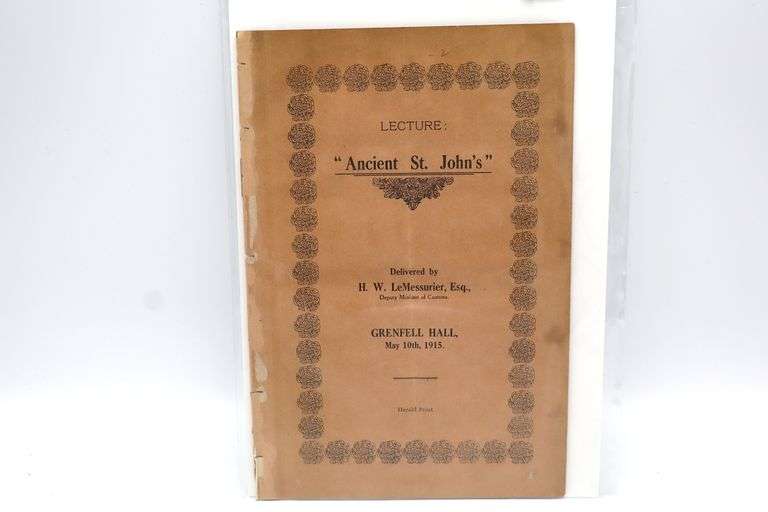
Lecture: Ancient St.John's by H W LeMessurier Esq. Grenfell Hall 1915
What it is
-
Title: Ancient St. John’s by Henry William LeMessurier (H. W. LeMessurier), Esq.
-
Lecture delivered: May 10, 1915 at Grenfell Hall, St. John’s, Newfoundland.
-
Publication: Appears as a monograph published by Herald in St. John’s, circa 1915.
-
Format: 20 pages, printed in double columns; size about 23 cm.
What it covers (Contents / Themes)
While I don’t have the full text’s detailed summary, the metadata and context suggest:
-
A historical account of old St. John’s (Newfoundland), focusing on its origins, early settlement, perhaps landmarks, important events, and how the town evolved. “Ancient St. John’s” suggests a retrospective on the city’s past—architectural, civic, ecclesiastical, maybe social history.
-
LeMessurier likely discusses early inhabitants, perhaps the colonial era, significant buildings or sites (church, public buildings, old streets), possibly divergences between old and modern St. John’s (circa 1915).
-
Given that the lecture is 20 pages, not extremely long, it may provide sketches of old families, old customs, the geography of early town layout, perhaps anecdotes or memories from older residents.
-
Might include commentary on preservation or the importance of memory — standard in local history lectures of that period.
Where to Access It
-
Digitally via Canadiana: The monograph Ancient St. John's is available in image form, with full‑document download as PDF of ~20 pages.
-
The original is held (or was used) by the National Library of Canada (since Canadiana notes that their copy was filmed from that collection)
Significance / Why It Matters
-
Provides a snapshot (in 1915) of how St. John’s people of that time thought about their city’s past — what was considered “ancient,” what landmarks were still standing, what histories were valued.
-
Useful source for local history / heritage studies: for mapping the older built environment, comparing what was then preserved vs what later changed, perhaps even buildings that no longer exist.
-
May include LeMessurier’s insights or original sources (oral histories, older maps, older documents) which might not be preserved elsewhere.
