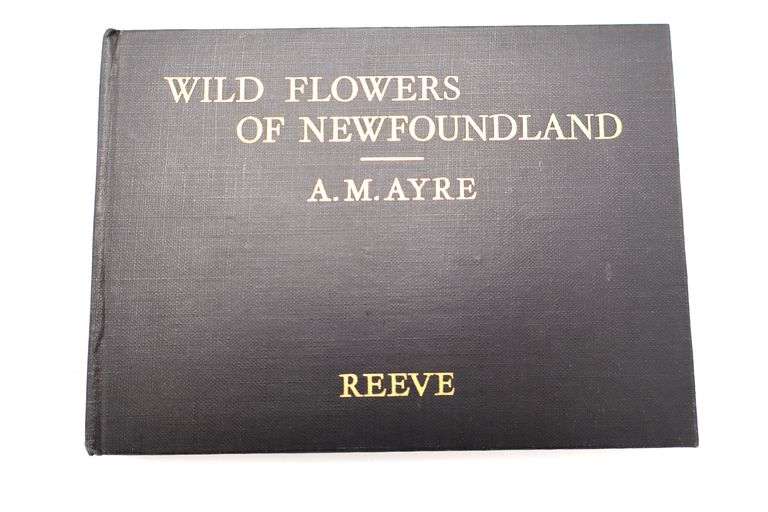
1935, Wild Flowers of Newfoundland by A.M. Ayre Part III
📘 Bibliographic Information
-
Title: Wild Flowers of Newfoundland : mainly Orchis‑, Willow‑, Buttercup‑, Mustard‑, Rose‑ Part III. Author: Agnes M. Ayre (1890‑1940) (also cited as “A. M. Ayre”). Place/Publisher: St. John’s, Newfoundland : A. M. Ayre; and Ashford, Kent : L. Reeve & Co., Ltd. (for overseas distribution) (1935) (Oblong Fcap. 8vo; pp vi + 231) Series: Part III only of a planned multi‑part series (Volumes I & II were apparently never published)
🧭 Content & Scope
-
The book concentrates on the wild‑flower flora of Newfoundland, with emphasis on several plant‐groups: orchids (Orchis), willows, buttercups, mustards, rose‐family plants. The subtitle lists “mainly Orchis, Willow, Buttercup, Mustard, Rose.”
-
It includes many illustrations (originally watercolour paintings by Ayre) and historical/ecological notes for each species. According to one commentary, the author had produced ~1,000 life‑sized watercolour paintings of Newfoundland flora, of which this volume drew. The preface reportedly indicates that due to cost constraints, the original paintings were altered (paint washed off, outlines retained) in the printed version to reduce publication cost.
✅ Significance
-
For botanical history in Newfoundland & Labrador, this work is important because:
-
It represents one of the early major pictorial/floristic works focused specifically on Newfoundland’s wildflowers (rather than general North American flora).
-
It provides documentation (illustrations + descriptions) of many species in the region as of the 1930s, which is valuable for historical comparison (e.g., changes in distribution, habitat).
-
Ayre being based in Newfoundland offers local insight, which is sometimes lacking in broader North American floras.
-
-
For the “flora of Newfoundland & Labrador” community, the book is cited in bibliographies of the province’s botanical literature: e.g., “Ayre, A.M., 1935. Wild flowers of Newfoundland. Part III. L. Reeve & Co., Ltd., Kent, England. (only Pt. III was published).”
⚠️ Considerations / Caveats
-
Although titled “Part III”, the first two parts were apparently not published, making this a standalone volume of a series. Thus it may not cover all intended taxa or regions.
-
Because it was privately produced (by the author) and printed in limited numbers, it may be harder to locate and less widely cited than larger floras.
-
The quality of reproduction (with the wash‐off of original painting mentioned) and some choice of species may reflect the author’s focus and resources rather than being exhaustive.
-
As with many older botanical works, nomenclature and taxonomic treatments will be dated; modern users should cross‐reference with current botanical sources for identification/validity.
