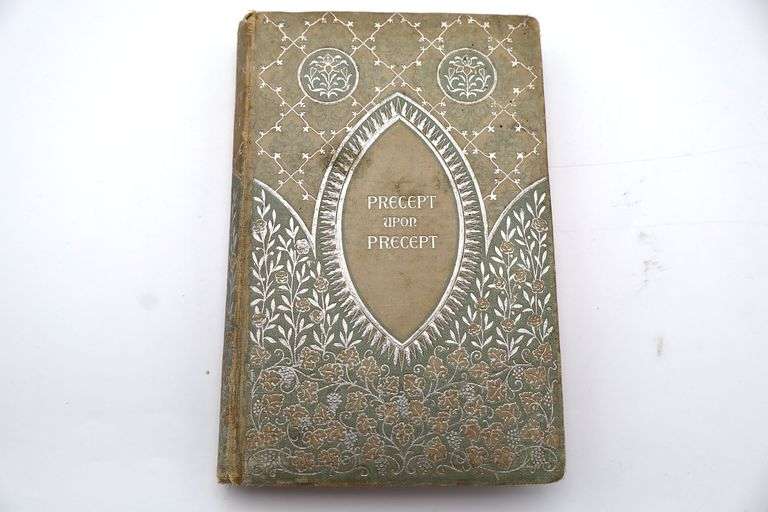
1898, Precept upon Precept by the Author of "Peep of Day", Favell Lee Mortimer, New York
📘 Bibliographic Information
-
Title: Precept Upon Precept: Being a Sequel to “The Peep of Day.”
-
Author: Favell Lee Mortimer (1802‑1878)
-
Publication: Various editions. The date “1898” you mentioned is not readily verified in online sources—the works appear earlier (e.g., late 19th century) and later re‑editions exist. For example one listing shows a 1913 edition. Publisher: Not fully verified for the 1898 edition. Some sources list “Ward, Lock & Co., Ltd.” for a 1913 edition.
-
Format / series: It belongs to her series of children’s religious instructional books (e.g., “Peep of Day”, “Line upon Line”, “Here a Little, There a Little”).
🧭 Content & Purpose
-
The book is designed as early religious instruction for children: simple lessons, questions, stories, biblical accounts, moral teachings. It is a “sequel” to The Peep of Day, continuing the same style of instruction and moral teaching.
-
The text was used in Sunday schools and by missionary/educational personnel, including translations into other languages (for example a Dakota‑language edition exists of “Precept upon Precept”).
✅ Significance
-
The book is relevant for the study of 19th‑century religious education, especially in Britain (and perhaps its export abroad) and in children’s literature.
-
It provides insight into how religious instruction was given to young children (methods, style, vocabulary) in Victorian times.
-
For anyone researching Favell Lee Mortimer’s works or the “Peep of Day” series, this is one of the key titles.
⚠️ Notes / Caveats
-
The exact 1898 edition you asked about is not clearly documented in the sources I found; many sources list earlier decades or later re‑editions but not explicitly 1898.
-
Because many editions, reprints and translations exist, publisher/place data can vary significantly.
-
As with many instructional/children’s religious books of the era, the viewpoints reflect their time (Victorian Christian pedagogy, certain moral assumptions) so modern readers should consider those historical contexts.
