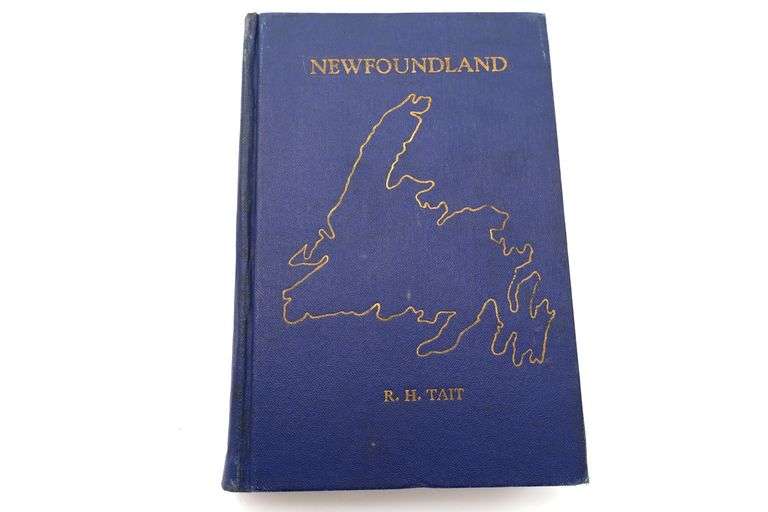
1939, NEWFOUNDLAND: A Summary of the History and Development of Britains Oldest Colony from 1497 to
✅ Bibliographic Details
-
Title: Newfoundland: A Summary of the History and Development of Britain’s Oldest Colony from 1497 to 1939. Author: Robert Holland Tait.
-
Date: 1939.
-
Publisher / imprint: Printed in the U.S.A. by The Harrington Press, as per the front‑matter of the book. Scope: Up to the year 1939 (so it covers roughly from the first European contact to the late 1930s) per the subtitle.
🧭 Content & Purpose
-
The book aims to present a concise historical summary of Newfoundland (and presumably Labrador) from its early discovery/claim (1497) to 1939.
-
The work appears to have been used as an information/propaganda‑type volume for the Newfoundland Information Bureau (Tait was involved with that bureau) in New York, so part of the purpose was perhaps to inform outsiders or potential visitors about Newfoundland.
-
It is illustrated (the front matter acknowledges use of photographs and plates from several sources such as Canadian Airways Ltd., Wendell P. Colton Co., Newfoundland Tourist Development Board) and includes a large folded map.
🎯 Significance
-
Because it covers a broad span of Newfoundland’s history (from early claims by Europeans onward) and was published in 1939, it offers a snapshot of how Newfoundland was being presented just before and at the start of World War II.
-
It may serve as a useful secondary source for researchers looking at how Newfoundland’s identity, development and place within the British Empire (and later within the North American context) were viewed in the late‑inter‑war period.
-
It also potentially contains historical data, illustrations, and maps which might not all be easily found elsewhere.
-
Given Tait’s association with Newfoundland informational/promotional efforts, it may reflect the public relations or tourism‑history dimension of Newfoundland as “Britain’s oldest colony”.
⚠️ Considerations / Caveats
-
As with any summary history from the 1930s, the book will reflect the historiographical assumptions, biases and limitations of its era (for example, colonial/imperial viewpoints, less emphasis on Indigenous perspectives, etc.).
-
Being written for an external audience (or partly promotional) it may omit certain social, economic or political complexities in favour of a more general narrative.
-
Because it stops at 1939, it does not cover events such as World War II, the Commission of Government during the war, or Newfoundland’s 1949 Confederation with Canada.
