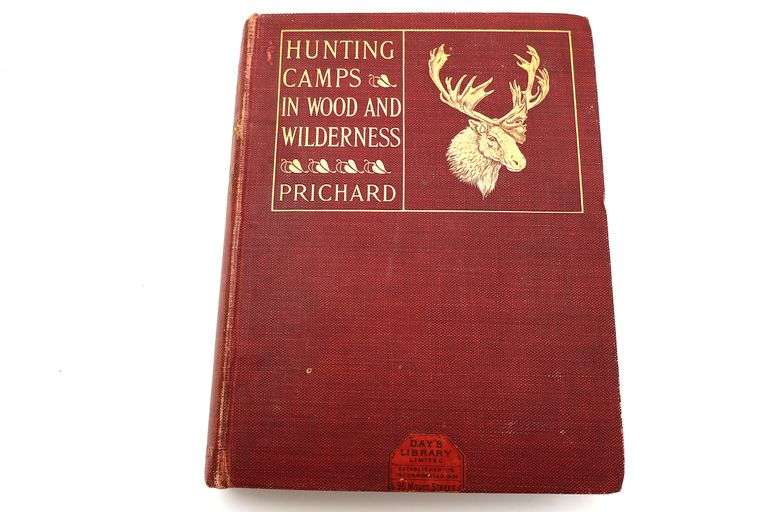
1910, Hunting Camps in the Wood and Wilderness by H. Hesketh Prichard, F. Z. S.
Author: Hesketh Hesketh-Prichard
-
Hesketh Vernon Hesketh-Prichard (1876-1922) was a British adventurer, sportsman, writer, explorer and big-game hunter.
-
He combined outdoor sport with travel and writing: his works cover Patagonia, the Canadian wilderness, Newfoundland, Labrador, and other remote locales.
-
Hunting Camps in Wood and Wilderness is among his more prominent works, showing his hunting expeditions and wilderness camps in various parts of the world.
The work: Basic facts
-
Title: Hunting Camps in Wood and Wilderness. With a Foreword by Frederick Courteney Selous, Gold-Medallist of the Royal Geographical Society. a
-
Published: London: William Heinemann, 1910. Also a U.S. edition: New York: Sturgis & Walton, 1910.
-
Format: Approx. 274 pages (some editions xx + 274), quarto size, illustrated with colour plates by E. G. Caldwell and drawings/photographs.
-
Content spans multiple expeditions: parts on Patagonia, the Andes, Norway, Newfoundland & Labrador, Canada. For example: “A fall hunting trip in Newfoundland”; “A September trip upon the Gander River, Newfoundland”; “Moose-hunting and moose-calling in Canada”.
Themes & content
-
Big-game hunting and wilderness adventure: The book describes hunting moose, caribou, elk, and other game in remote wood and wilderness settings.
-
Multiple geographies: The author travels widely — from the Pampas of Patagonia, to the Cordillera of the Andes, to Labrador/Newfoundland, to Norway.
-
Camp-life in remote places: The title emphasizes “hunting camps” which means the book gives substantial attention to living in remote wilderness: setting up camp, the challenges of travel, weather, terrain, and the hunting logistics.
-
Illustrative detail: It includes photographs and colour plates capturing game, landscape, hunting scenes — valuable for historical visuals of early 20th-century wilderness sport.
-
Colonial/imperial sporting mindset: The tone and approach reflect early 20th-century British imperial sporting culture — exotic wild places as sporting grounds, and the author as gentleman hunter/traveller.
Significance
-
For historical research into wilderness hunting, outdoor sport, and exploration in the early 20th century, this work is a useful primary source: it conveys how remote Canadian (and elsewhere) hunting and wilderness travel were experienced and narrated during that era.
-
It contributes to Canadian (and particularly Newfoundland & Labrador) historiography of outdoor sport and wilderness: e.g., the reference in another work: “Hesketh Prichard … in Hunting Camps in Wood and Wilderness (1910)… observed that Middle Ridge, and the territory west of it ('the Burnt Lands') was ‘one of the chief hunting grounds of the Micmac Indians…’”
-
It is of interest to those studying the cultural history of hunting, the representation of wilderness, colonial sport, and also the transformation of remote landscapes through recreation and exploration.
Things to watch / caveats
-
Perspective & bias: Being a sporting travel book from 1910, the viewpoint is that of a British big-game hunter/imperialist era traveller. There may be limited recognition of Indigenous perspectives, and the language may reflect the racial and cultural attitudes of its time.
-
Use as historical source with caution: While it gives vivid descriptions, the emphasis is on sport rather than social history; for example, treatment of Indigenous land use, environmental change, or settler-Indigenous relations may be superficial or framed in the hunting narrative.
-
Sport vs conservation: The hunting mindset in the book precedes modern conservation or wilderness-preservation frameworks; so interpretations of wilderness will reflect its era’s sporting ethos.
-
Edition variations: Some editions may vary (e.g., UK vs U.S., number of plates, untrimmed edges). If using for academic citation, check the exact edition you have.
-
Geographic accuracy: While the author travelled widely, some of the descriptions may be stylised or emphasised for narrative effect; cross-checking with more technical/geographic sources may be useful if one is using the text for location-specific detail.
How you might use the book
-
As a primary source for understanding how wilderness hunting and remote camps were experienced and written about in the early 20th century.
-
For illustrative and descriptive material on wilderness camps in Newfoundland, Labrador, Canada (e.g., descriptions of Gander River, caribou hunting) which may serve in geography, cultural history, or eco-history research.
-
As part of a study of sporting culture in the British Empire / Canada: how big-game hunting was part of exploration, masculinity, colonial identity.
-
As a visual source via plates/photographs: to see historical hunting camps, wilderness settings, early photographic representation of remote camp life.
-
For comparative analysis: how hunting narratives from 1910 compare to later wilderness tourism/travel narratives or to Indigenous accounts.
