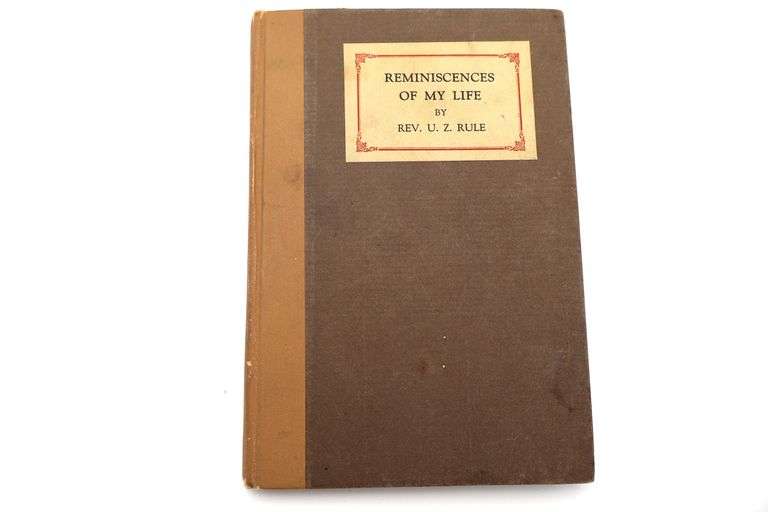
1927, Reminiscenses of My Life by Rev. U. Z. Rule. The first Missionary to the Bay of Islands and Bo
Basic details
-
Title: Reminiscences of My Life.
-
Author: Ulric Zuingli Rule (often given as U. Z. Rule) — Anglican clergyman who served the mission in the Bay of Islands (western Newfoundland) as the first resident clergyman.
-
Publication: St. John’s: Dicks & Co. Ltd., 1927.
-
Subject: The book recounts Rule’s life and experiences, especially his time in western Newfoundland (Bay of Islands area) from around 1865 to 1872. It describes mission work, community life, settlement conditions, travel and ministry on the “wild coast.”
What the book is about
-
Rule arrived on the northwest coast of Newfoundland in 1865 and made Birchy Cove (later Curling) in the Bay of Islands his headquarters.
-
The mission territory was expansive and scattered: from the Bay of Islands up to Daniel’s Harbour and including many outports.
-
The text includes descriptions of early community conditions: lack of formal schooling, very sparse clergy presence, reliance on ship-routes for mail and supplies, rudimentary infrastructure. For example:
“Yesterday I received a letter … the stamp put on it brought it all the way to Bay of Islands without any additional charge… we are … fairly within range of the post office; so that instead of paying an Indian letter carrier a dollar for each letter … now we have a post-office here…”
-
It also notes the process of establishing church presence, education, and mission work among dispersed settlers. For example: Rule found “no formal attempt being made to educate the people” when he arrived.
Significance
-
The book is a valuable primary source for the history of the Anglican mission and Western Newfoundland (especially Bay of Islands / Bonne Bay area) in the mid-to-late 19th century.
-
It provides first‐hand insight into settlement issues, travel and communication challenges, church and educational development in remote outports.
-
For historians of Newfoundland & Labrador, the mission field, or church-community interactions in remote coastal areas, Rule’s account offers detail not always found elsewhere.
-
It helps illustrate the social conditions of the era: scattered settlement, heavy reliance on sea transport, very limited infrastructure, church and mission as important social institutions.
Things to watch / caveats
-
As with many missioners’ reminiscences, the perspective is from a religious/Anglican missionary vantage; Indigenous perspectives, non-Anglican viewpoints or community self‐narratives may be under-represented.
-
The text is written in 1927, many years after Rule’s service (1865-1872). Some recollections may be idealised or affected by memory.
-
The mission context (1860s western Newfoundland) was very remote and conditions were harsh; Rule’s observations may focus more on what he encountered but less on underlying economic, Indigenous or environmental factors in depth.
-
For detailed demographic or economic history, cross-check with other archival or local records (church registers, census, local histories).
How you might use the book
-
As a source for the history of the Bay of Islands / western Newfoundland region: settlement, church, mission, education, infrastructure around 1865-1872.
-
As part of church history research: early Anglican mission work in Newfoundland, establishment of clergy in outports, and church-community relationships.
-
For social history: conditions of isolated outport life, communications, transport, education in remote coastlines.
-
For genealogical or local history: Rule mentions names, events and people in the region; could help contextualise other family/community histories.
-
For comparative analysis: comparing mission accounts with secular or Indigenous sources to build a fuller picture of the era.
