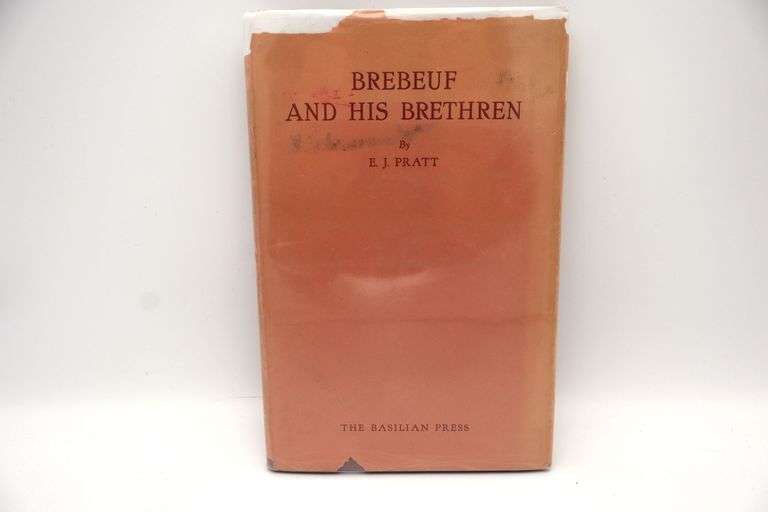
1942, Brebeuf and His Brethren by E. J. Pratt
Author: E. J. Pratt
-
Edward John “E. J.” Pratt (1882-1964) was a prominent Canadian poet, known for his narrative and epic‐style poems.
-
He often explored large historical or natural themes (the sea, wilderness, Canada’s past) in his work, blending rigorous research with poetic voice.
-
Brébeuf and His Brethren won the Governor General’s Award for Poetry in 1940.
The work: Basic facts
-
Title: Brébeuf and His Brethren.
-
Although you referenced “1942”, most sources list its first publication as 1940.
-
It is an epic‐length narrative poem, in blank verse, recounting the story of Jean de Brébeuf and his fellow Jesuit missionaries working among the Huron people in 17th-century what is now Canada.
-
The poem is available in full via Project Gutenberg Canada.
Themes & content
-
Missionary endeavour & martyrdom: The poem portrays the Jesuits' arrival, their work in harsh conditions, encounters with Indigenous peoples, conflicts, and the eventual martyrdom of Brébeuf and others.
-
Wilderness & survival: The savage Canadian frontier features heavily—the rivers, the forests, the portages, the winter cold. For example, Pratt writes of canoe routes, the cabin smoke, mosquitoes, freezing temperatures.
-
Cultural encounter: There is attention to the interaction between European missionaries and Indigenous people (Huron, Iroquois). The language, the rituals, the conflict of belief systems appear.
-
Sacrifice & faith: The poem is deeply rooted in Christian imagery—crosses, martyr’s wounds, service in spite of danger. The idea of giving one’s life “for the cause” is central.
-
Canadian identity & history: Although grounded in 17th-century events, the poem contributes to the larger narrative of Canadian history—exploring how early colonial and Indigenous histories shape Canada’s story.
Significance
-
It is widely regarded as one of the major Canadian epic poems of its era, illustrating Pratt’s ambition to treat Canadian subject matter with the weight and style of classical epics.
-
The poem offers rich historical detail (though poetic) and has been used by literary scholars to discuss how Canada’s past is poetically represented.
-
It shows Pratt’s stylistic strength: combining narrative, historical documentation, poetic imagery and formal control.
Points to watch / criticisms
-
Perspective & bias: As with many works of its time, the representation of Indigenous peoples is from a European/missionary viewpoint. Contemporary readers should be aware of the colonial framework that underpins much of the narrative.
-
Historical vs poetic license: While grounded in real events, the poem takes liberties for dramatic or poetic effect. If you are using it as a historical source, you should cross-check with primary historical documents.
-
Language & style: The poem uses somewhat elevated, formal language and may feel dense. Its epic length means it requires commitment.
-
Cultural sensitivity: Some descriptions or attitudes may reflect earlier 20th-century norms which do not align with modern Indigenous‐centred perspectives.
Use in research or reading
-
If you’re studying early Canadian mission history, the Huron-Jesuit period, or representations of colonial contact, this poem gives a rich literary lens.
-
For poetry or literature courses focused on Canadian identity, this is a key work in the canon.
-
As a devotional or spiritual text, it may appeal to those interested in martyrdom, sacrifice or Christian mission narratives – though one should engage critically.
