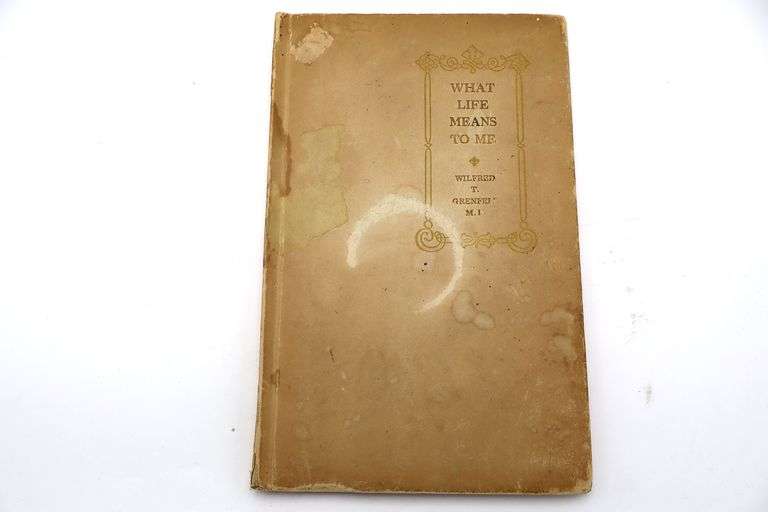
1910, What Life Means to Me by Wilfred T. Grenfell, M.D.
Basic details
-
Title: What Life Means to Me (Boston: Pilgrim Press, 1910) according to the digital archive.
-
Author: Sir Wilfred Thomason Grenfell (1865-1940).
-
Content: A short work (≈32 pages in the 1910 edition) in which Grenfell reflects on his life, work, faith, and what gives meaning to his existence in the context of his mission among the fishermen and coastal communities of Newfoundland & Labrador.
Why it’s significant
-
Grenfell is a key figure in the medical-missionary work in northern Newfoundland and Labrador; his work included establishing hospitals, schools, industrial co-ops, and social welfare in remote communities.
-
This book offers insight into his personal philosophy: service, faith, sacrifice, and how he viewed his life’s purpose. For example, one source notes:
“…in his book What Life means to Me Grenfell says, ‘To me now any service to the humblest of mankind is Christ-service.’”
-
The work is a primary document for understanding early 20th-century missionary ethos in Newfoundland & Labrador, and offers a window into how Grenfell articulated the meaning of his life in the context of that work.
Key themes & take-aways
-
Service & altruism: Grenfell emphasizes that meaningful life comes through giving and serving others, especially those in remote or disadvantaged situations.
-
Faith and mission: While not a long theological treatise, the book is rooted in Grenfell’s Christian commitment and the vocational sense of his work in the “wilds” of Newfoundland & Labrador.
-
Meaning in hardship: Given the harsh conditions of his mission territory (remote coastlines, difficult travel, extreme weather, isolated communities), Grenfell reflects on how challenges shape and refine purpose.
-
Personal conviction: It’s more of a reflective essay than a full memoir, suited to readers interested in the inner life of a missionary/physician rather than a detailed operational history.
Things to keep in mind
-
The book is quite short (≈32 pages in the edition referenced) — it is more devotional/reflective than comprehensive biography.
-
Given the era (1910) and Grenfell’s context, the perspective is missionary-centred and the book likely reflects the assumptions and language of its time.
-
If one is doing in-depth historical research on Newfoundland & Labrador mission work or Indigenous communities, it should be supplemented with other sources (including later critical scholarship) to provide fuller context.
How you might use the book
-
As a primary source for understanding Grenfell’s ethos and mission-vision around 1910.
-
As a supplementary reading when studying the history of the International Grenfell Association (which developed out of Grenfell’s work) and its role in Newfoundland & Labrador.
-
As inspiration or illustrative text on themes of vocation, service, faith in challenging environments.
